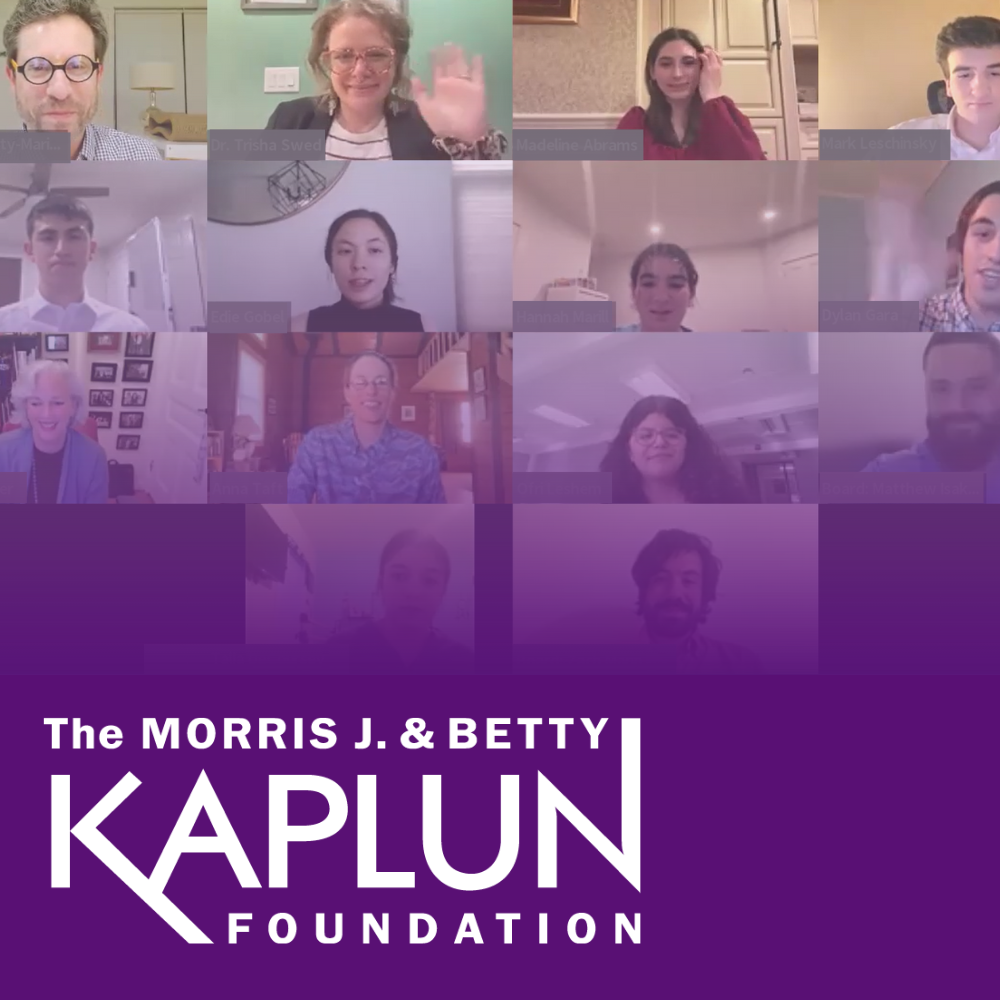
A little less than a decade ago, most teens hadn’t heard of Zoom, but by the end of 2020, it had become a necessity for millions of learners. When the time finally came to return to the classroom, many educators were all too excited to go back.
But there was one program that saw beyond the “Brady Bunch” grid of faces and seized the opportunity to lean into online learning. While others were reluctant to continue virtual education, The Morris J. & Betty Kaplun Foundation doubled down on the online model of programming for its youth board. Several years later, they haven’t looked back and participants are still logging in from across North America.
The Kaplun Youth Board is relatively new compared to the 32-year-old essay contest that the foundation has been hosting since 1989. Starting in 2019 the Kaplun Foundation began inviting applicants from their renowned essay competition to participate in a youth philanthropy experience.
The contest is not only an opportunity to reach hundreds of students from across the nation and sometimes worldwide, but also serves as a recruitment tool and is a prerequisite for participating in the foundation’s youth board. David Connerty-Marin, President of the Kaplun Foundation, shared “the level of commitment and engagement from youth board members tends to be quite high.” He attributed this overall disposition to the foundation’s recruitment model and believes there is benefit to involving teens directly from the essay experience. “From the moment the teens walk through the virtual door they come prepared to dig deep and engage in meaningful conversations. Having already invested their time reflecting on a thought-provoking question to better understand themselves, their communities, or the world around them, they arrive prepared to grapple with complex topics and equipped to give with intention.”
This year, the foundation challenged essayists to think about two questions including for 7th-9th graders: The Talmud says, “Who is wise? One who learns from every person.” Share an example of something meaningful you learned from someone unexpected.
At the same time, they asked 10th-12th grade applicants: Elie Wiesel wrote: “The opposite of love is not hate, it is indifference.” How does Judaism challenge us to confront indifference, and how might you respond to injustice in your own life?
What sets the Kaplun Youth Board apart from many of its counterparts in the youth philanthropy world is that this group meets exclusively online. This format brings people together from coast to coast, across time zones, and even overseas, including one participant from India. This digital shift has also allowed for a significant expansion of the initiative. What began as a one-day in-person giving experience, evolved into a comprehensive 11-session model and enabled the group to move away from using a predetermined list of grantee organizations to a more standardized RFP process.
Maintaining a successful online learning experience is not without its challenges. Reduced attention spans for Gen Z and Gen Alpha along with Zoom fatigue remain an issue. Recognizing these obstacles, the Kaplun Foundation has been able to meet them head on by ensuring they have a charismatic and knowledgeable facilitator who is skilled at building interactive, engaging spaces online. “The magical thing about getting to be a part of this work is creating a space where young people from all over the country can talk about the causes that are important to them”, commented Dr. Trisha Swed, the program’s facilitator, “this becomes a real-time vehicle for young people to connect with new ideas and make a real impact on causes that are important to them.” In addition to programmatic strategy, the Kaplun Foundation has also responded directly to participants’ concerns by adjusting the length of sessions, shortening screen time from 90 to 75 minutes.
Over the last 7 years this initiative has quickly grown, and now, due to the popularity of the youth philanthropy program, the Kaplun Foundation introduced an alumni board, inviting Kaplun Youth Board members to return for a subsequent grantmaking experience. This year the alumni program will meet across 4 sessions, delving into a newly created Honeycomb curriculum focusing on giving towards combating antisemitism.
Looking ahead, The Kaplun Foundation is excited to build on its partnership with Honeycomb. Having witnessed firsthand the benefits of the Combatting Antisemitism curriculum, the Kaplun Foundation is proud to support its expansion by funding the new initiative, “Spreading LIGHT”, which Honeycomb will launch later in 2026. In addition, Honeycomb will continue collaborating with the Kaplun Foundation, collecting valuable feedback that will help to shape and improve the experience in the long run for all participants.
————————————————————————-
The 2025/2026 Kaplun Youth Foundation Mission Statement is: Guided by the Jewish Values of Dignity, Justice and Hope, the Kaplun Foundation Youth Board seeks to support organizations that bring awareness to women’s health disparities, promote educational advocacy, and provide resources to those in need, empowering women in the pursuit of gender equity.
The 2025/2026 Alumni Board Mission Statement is: As a board of college aged philanthropists we are interested in safeguarding the physical and social security of the Jewish community through fresh perspectives toward education, literacy, and empowerment. By increasing access to knowledge, fostering critical awareness, and strengthening communal understanding, we seek to collaborate with organizations that work to equip individuals with the tools to protect themselves, support one another, and build resilient, informed communities for the generations to come.
————————————————————————-
If you would like to learn more about the Kaplun Youth Foundation, the essay contest, or their online model, please reach out to [email protected].
Interview and Article by:
Alana Hollander, Writing Consultant for Honeycomb