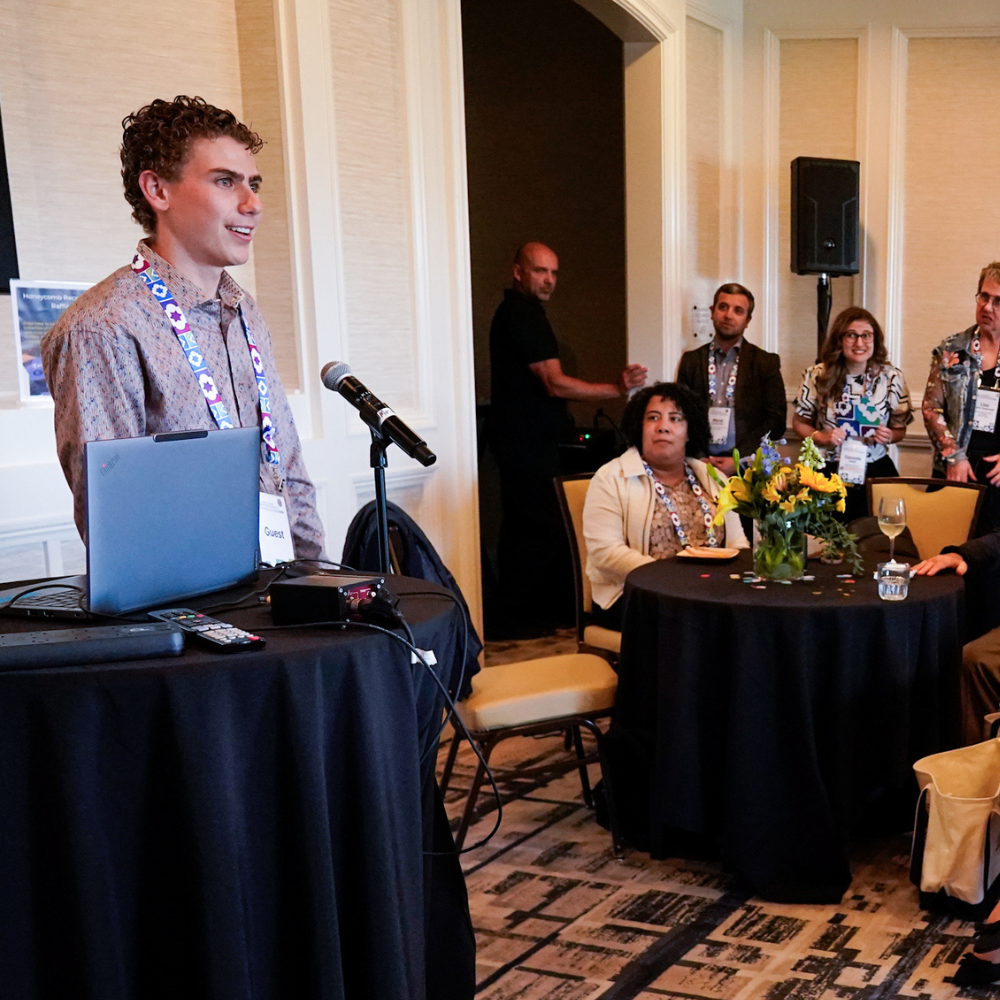
To celebrate Honeycomb’s 20th anniversary, and to honor the work of the Jewish Teen Foundation hosted at the Jewish Community Foundation San Diego, three incredible teens presented at the Honeycomb reception at the Jewish Funders Network International Conference in March 2026. Read their thought-provoking speeches below:
TALIA SCHATZ
My name is Talia Schatz and I am a sophomore at Scripps Ranch High School. I am honored to be here to share about a program that is very meaningful to me, the Jewish Teen Foundation of the Jewish Community Foundation in San Diego. I am a legacy at JTF; my older sister joined JTF in her high school years. So, while it was expected of me to join when I reached 9th grade, my experience in JTF has been uniquely mine and become the highlight of my weekends.
It has been a great opportunity for me in many ways. Not only have I gotten to meet other Jewish teens around San Diego, but I have also helped many people financially, medically, therapeutically, educationally, etc. As members of JTF, we establish a new mission statement each year after discussing and coming to a consensus on a topic we’re passionate about. Then, we’re tasked with researching organizations, sending out Requests for Proposals, and interviewing the non-profit organizations we believe are the ideal fit for our mission. Our research looks into both San Diego and Israel-based non-profit organizations, and this year, we’re also working with organizations in Tijuana, Mexico, to help underprivileged children get the education they deserve.
Being part of this process has shown me how much thought and collaboration goes into philanthropy. Each step requires discussion, research, and teamwork as we work together to decide how we can make the greatest impact as a group. It’s a unique experience to be trusted with real decisions about where funding should go and how we can support communities that need it most.
The foundation has taught me so much. As a high schooler, I know the definition of RFP. JTF has taught me tools that I will be able to carry with me for my whole life, things that school does not teach. While reviewing proposals, conducting site-visits, and raising money for our grants, I am gaining the skills of active listening, public speaking, and learning about my personal values.
I have also learned how to listen to different perspectives, ask thoughtful questions, and work with others to come to decisions that reflect the shared values of our group. Those experiences have helped me grow not just as a student, but as a leader and a member of my community.
The professional atmosphere guided by Jewish values is an experience unlike any other. Learning about philanthropy and taking part in it is such a privilege. Through JTF, I have learned that giving is not only about financial support, but about responsibility, compassion, and strengthening the communities around us.
I am incredibly grateful to be part of a program that allows teens like me to learn these lessons so early, and I know the experiences and values I’ve gained through JTF will stay with me for the rest of my life.
LEVI PASCAL
Hi, my name is Levi Pascal, and I’m a senior at Carlsbad High School. This past year, I had the opportunity to join the Jewish Teen Foundation.
I originally joined JTF because several friends who traveled with me on the San Diego Jewish Community Foundation trip to Europe this summer suggested it. They told me it was an amazing experience, and I was interested in developing skills in philanthropy and grant writing, especially through a Jewish lens.
Over the past year, JTF has given me a much deeper understanding of how nonprofit organizations actually work. One of the most valuable parts of the program has been researching nonprofits in depth. We look at their missions, their programs, how they measure impact, and how they use funding. Learning how to analyze that information and ask the right questions has helped me develop research and critical thinking skills that I know will be valuable in college and beyond.
Another thing that has really stood out to me is the experience of working with a group of teens who all come from different schools, backgrounds, and perspectives. Everyone brings different ideas and different levels of knowledge about philanthropy and the issues we’re discussing. Being part of those conversations has taught me how to listen carefully, respect different viewpoints, and help move discussions toward a productive outcome.
Through that process, I’ve also had the chance to step into leadership roles. When you’re part of a group that is making real funding decisions, you have to help guide discussions, ask thoughtful questions, and work toward a decision that reflects the values of the whole group. Learning how to collaborate, build consensus, and take responsibility for those decisions has been one of the most important leadership lessons I’ve gained from this experience.
This year, I served on the board that focuses on organizations providing healthcare access to vulnerable communities in both Israel and San Diego. Learning about the barriers people face in accessing healthcare—and the organizations working every day to address those challenges—has been incredibly meaningful. It showed me how leadership and philanthropy can work together to create real change for people who need support the most.
One of the biggest takeaways for me from JTF is that leadership doesn’t always mean being the loudest person in the room. Sometimes it means listening, asking good questions, and helping a group move forward together. Through a Jewish lens, we talk about values like tzedakah and caring for others, and JTF really brings those values to life by giving teens the opportunity to practice leadership while making thoughtful and impactful decisions.
Being part of JTF has helped me grow as a researcher, a collaborator, and a leader, and it’s an experience I know I’ll carry with me long after high school.
Thank you.
SARAH DATNOW
Good evening. My name is Sarah Datnow, and I’m a senior at the San Diego Jewish Academy and a member of the San Diego Jewish Teen Foundation, which is part of the San Diego Jewish Foundation.
When people talk about philanthropy, they often frame it as generosity. At least that’s how I always thought about it.
But sitting in a room with thirty other Jewish teenagers deciding how to allocate tens of thousands of dollars quickly changed the way I think about giving. Because generosity is actually the easy part.
The harder question is prioritization.
Every organization we consider is doing meaningful work. Every cause represents people whose lives could genuinely improve with support. But, as you all know, we can’t fund everything. So the real challenge becomes deciding where our responsibility lies.
That is, in many ways, a deeply Jewish question.
In Hebrew, the word we often translate as “charity” is tzedakah, but its root is tzedek—justice. Giving, in a Jewish sense, is not understood only as generosity. It is also about obligation: recognizing that when the world is unequal or unjust, we are responsible for helping repair it.
Jewish tradition doesn’t stop at encouraging generosity—it also wrestles with how that responsibility should be carried out. Rabbinic texts debate the priorities of giving: whether immediate survival outweighs long-term change, whether proximity creates greater obligation, and how communities balance their responsibility to their own members with their responsibility to the broader world.
Jewish law teaches that communities should first ensure that the needs of people around them are met. The Torah instructs us in Devarim not to “harden our hearts or close our hands” to those in need within our gates. At the same time, the Shulchun Aruch emphasizes the unique responsibility Jews have toward the community in Israel.
In our meetings, we actively decide how to apply those priorities. Each year, our cohort allocates funds both locally in San Diego and in Israel.
There is another idea in Jewish thought that I’ve come to appreciate through JTF: that the goal of giving is not just to perform acts of generosity, but to become the kind of person whose instinct is to care for others.
In other words, philanthropy isn’t only about what we give. It’s about who we become.
Programs like JTF are important because they allow young people to step into that tradition early. They teach us that philanthropy is not separate from Jewish life or Jewish learning, but an expression of it. Through the process of learning, debating, and deciding together, we begin to understand what responsibility to our communities actually looks like.
And realizing that — even as teenagers — we are already participants in that ongoing Jewish conversation about justice and responsibility. And this has changed the way I think about both philanthropy and my place within the Jewish community.
Thank you.
————————————————————————-
If you would like to learn more about the Jewish Teen Board at the Jewish Community Foundation San Diego, please reach out to Rachael Cunningham, Program Officer, rachael@jcfsandiego.org.