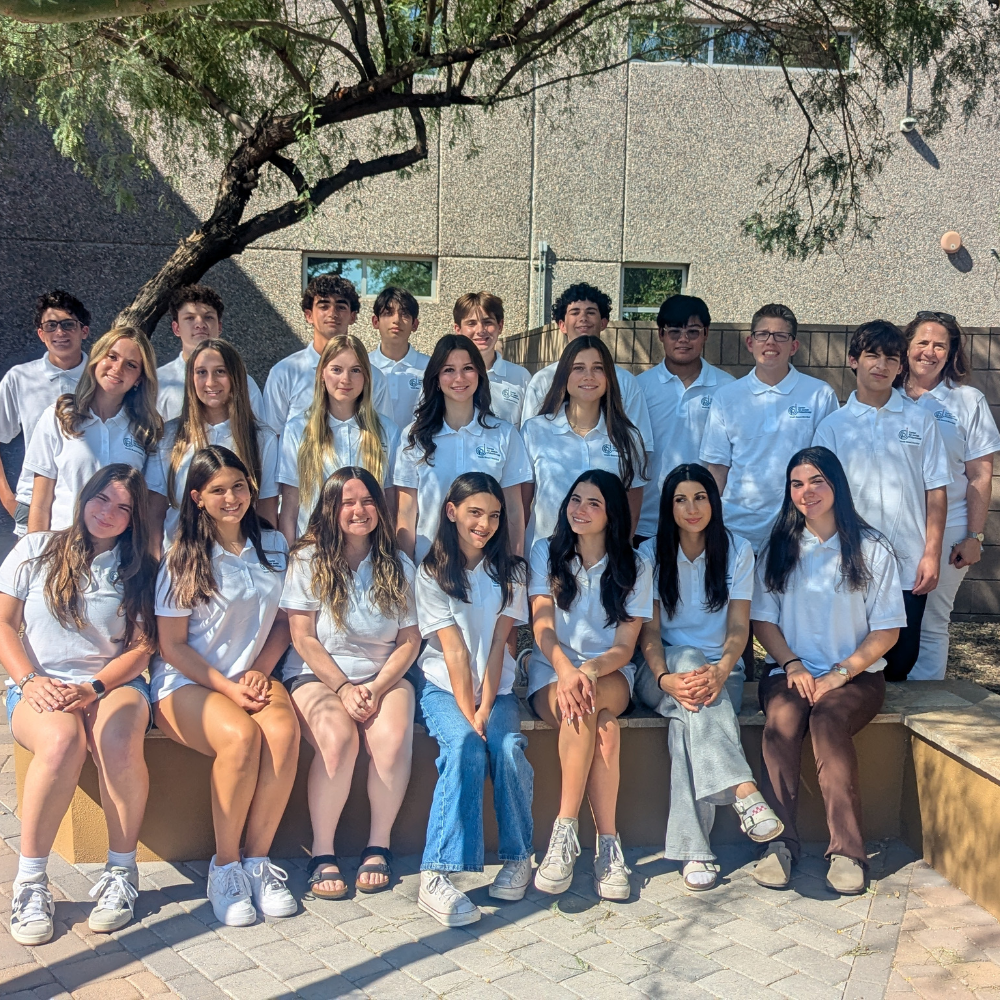
Lin-Manuel Miranda isn’t the only one who knows the importance of being “in the room where it happened.” At the Center for Jewish Philanthropy (CJP) in Phoenix, they reserve a seat every year on the Board of Directors for two outstanding youth philanthropists. These chosen representatives get seats at the table in the room where things happen, helping to shape and contribute to decision-making processes at the foundation, while also learning what it means to serve as leaders in their local Jewish community.
Mason Zinman is a junior at Brophy College Preparatory and Michelle Schwartz is a junior at Phoenix Country Day School. Now in their third year of the CJP Youth Philanthropy Board, they have also completed the first quarter of a two-year term as teen representatives for the CJP Board of Directors.
A true L’dor V’dor (generation to generation) moment taking shape, both Mason and Michelle are the grandchildren of highly engaged members of the community. Mason, the grandson of Ann Zinman, former Federation Board Member and Campaign Chair, and Michelle, granddaughter of Marcia Weisberg, former Director of the Jewish Community Foundation, were inspired by their grandparents’ involvement in the community. In fact, it was in 2006 that Marcia Weisberg welcomed a committee into her living room to discuss the idea of bringing a new youth philanthropy program called B’nei Tzedek to the foundation. Twenty years later, things have come full circle. Her granddaughter, Michelle, is now following in her footsteps.
Sitting on the Board of Directors, Mason and Michelle have the unique opportunity to take their grantmaking experience from the CJP Youth Philanthropy Board and see it applied through the lens of board governance, gaining insights on operational approaches and budget management. They are entrusted with confidential information and get to vote alongside the seasoned adult board members.
Reflecting on what she has observed so far, Michelle shared, “I’ve learned how to handle conflict and debates within a board. For example, I’m currently serving on my BBYO board, and this past term, I was president. Being on the Board of Directors at CJP taught me a lot about compromise and most importantly, I’ve been able to bring what I’ve learned into my other leadership positions at BBYO and at the CJP Youth Philanthropy Board.”
But the teens are not the only ones to benefit. The adults gain just as much from the experience by having teens join them at the table. Mason shared how he and Michelle are often encouraged to weigh in on issues and funding decisions involving youth programs and engagement. “They’ll call on us specifically and ask for our input. The other board members appreciate our reflections and what we say can potentially impact a decision, especially for youth engagement.”
Including teen representatives on the Board of Directors became a standard practice when the current CEO, Rich Kasper, first joined the Foundation. According to Andrea Cohen, Senior Director of Jewish Life, it was Kasper that had the vision to bring this idea to life. “We were talking, and Rich was adamant.” Andrea recalled him saying, “ ‘It’s not enough for us to say, they’re the future. They’re going through an comprehensive process and we’re trusting them with real dollars. We should have representation on the Board of Directors.’ This allowed the Board to witness the deep impact youth philanthropy training has on these young people and why we do what we do.”
For some, the idea of teens on a Board of Directors seemed like a radical move. There can be hesitation to try something new, and yet, these young representatives have proven time and again that they are up to the challenge and have added invaluable contributions to the group. Andrea explained, “Once the board members have experienced it for themselves, there’s a lot of pride they feel listening to the teens. They make articulate, well-reasoned points about board issues and they bring a fresh perspective.”
For anyone who may be considering including youth philanthropists on an adult board or committee, Andrea recommended certain key practices to ensure a successful experience:
- Require applicants to complete at least one year on a youth philanthropy board before being invited to sit on an adult board.
- Reserve two seats at a time so they have a peer to share the experience with.
- Consider a two-year term and differentiate the school years of the two teens so that the older board member can mentor the incoming representative.
- Make sure there is an adult identified that the teens know they can go to for guidance.
- Encourage teen representatives to take what they’ve learned on the adult board and apply it back to their youth philanthropy boards and in other places.
In the end, Andrea emphasized that the point of this initiative is not symbolic or performative, but rather a real opportunity for empowering emerging leaders. “We’re not just telling teens that they’re the future. We’re not saying, one day you get to do this, instead, you get to be in the room where decisions are made now.”
————————————————————————-
CJP Youth Philanthropy Board Mission Statement 2025-2026
Recognizing the historic commitment of the Jewish people to making the world a better place, the board provides grant support to organizations engaged in combating hate. The board is focused on work being done to address antisemitism, anti-racism, civil rights and working to create a culture of inclusivity. The values that will inform our decision making are: justice (tzedek), respect (kavod), loving kindness (g’milut chasidim), and hope (tikvah).
————————————————————————-
If you would like to learn more about the CJP Youth Philanthropy Board, or about including youth philanthropists on your adult boards or committees, please reach out to Andrea Cohen, Senior Director of Jewish Life, acohen@phoenixcjp.org.
Interview and Article by:
Alana Hollander, Writing Consultant for Honeycomb